Securing a Climate-Ready Water Supply
How Altis Is Building Resilient Water Management
Context
Altis is responsible for supplying water to part of the Canton of Valais in Switzerland, managing a network that has expanded gradually in step with local needs and growing investments.
Like many drinking water producers and distributors, the company must now operate in a rapidly changing environment: climate change is increasing the frequency of droughts and making available volumes more variable. These natural pressures may be compounded by non-climate-related events, such as infrastructure failures or an unexpected surge in demand for a particular use. As a result, traditional distribution and restriction approaches are no longer effective and may even lead to shortages and conflicts among major water users, including tourism, agriculture, golf courses, snowmaking, drinking water production and hydropower generation.
To continue providing reliable service, Altis needed a complete, up-to-date picture of its network, a better structure for its internal knowledge, and tools that would support informed, defensible decisions.
The company chose to address these issues proactively by focusing on data quality, operational continuity and a strategic view of the resource. With these goals in mind, it turned to WaterShed Monitoring..
Challenges
Altis faced several structural challenges that limited its ability to manage water distribution effectively:
- Some infrastructure was not integrated into the SCADA system, which no longer accurately reflected field conditions. This type of gap, common in networks that have evolved in stages, can create significant operational risks, particularly during sensitive system operations.
- Only one person had the expertise required to operate the system, a critical issue in terms of knowledge management. The lack of formal documentation or standard operating procedures (SOPs) made the organization vulnerable, and complicated planning, succession training, and operational continuity.
- Climate change is fundamentally reshaping the region’s water context. Historical models and allocations based on legacy contracts no longer match the volumes actually available, while major users operate in silos: the distributor has limited visibility into their true needs, and their internal contingency plans are rarely shared. This lack of transparency can lead to arbitrary decisions, such as imposing water shutoffs without a system-wide perspective, which can intensify tensions among stakeholders.
Solutions
WaterShed Monitoring structured its work around three priorities: data quality, knowledge management and water accounting.
Network inventory and update
A comprehensive inventory provided an up-to-date picture of the network, incorporated recent infrastructure, and validated the quality and completeness of existing data. The team identified critical gaps—including missing bathymetric data for the water source, which is essential for estimating available volumes—and corrected inconsistencies in the SCADA system.
This often invisible but decisive step gave Altis a consolidated view of its water assets, which is essential for planning investments, optimizing operations, and securing long-term supply.Capturing and structuring operational knowledge
Altis had strong internal expertise, but much of it was informal. WaterShed Monitoring worked with its teams to capture unwritten knowledge, document practices and turn them into SOPs. This process reduced dependence on a key individual, supported succession training, and strengthened organizational resilience.
Establishing an allocation plan and water accounting framework
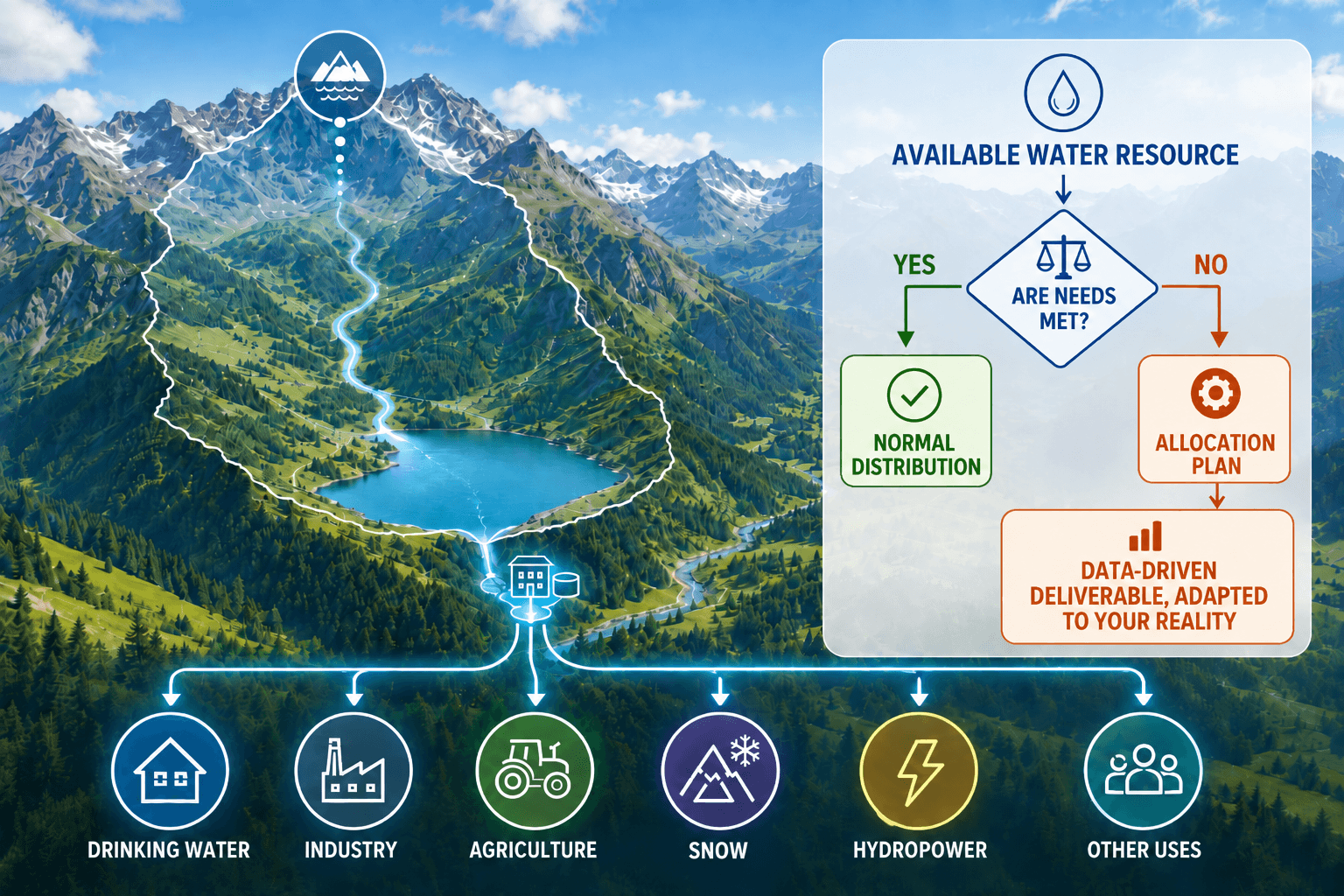
To address the resource’s growing unpredictability, WaterShed Monitoring designed a decision-support tool incorporating accounting principles and built on three elements:
- an assessment of available resources based on reservoir lake bathymetry and recharge time;
- an analysis of different users’ actual needs through participatory workshops, creating two-way communication channels among stakeholders;
- a transparent allocation mechanism that takes major users’ contingency plans into account.
This approach not only establishes priorities for water use, but also allows adjustment of resource redistribution in near real time—down to minute-by-minute management during critical periods.
This framework shifts management from a reactive model based on assumptions to strategic governance that supports informed, equitable decisions grounded in reliable data.
Results
As a result of this work, Altis now has:
- a clear, up-to-date view of its network;
- a consistent, usable operational database;
- documented standard operating procedures (SOPs) to ensure operational continuity;
- a precise understanding of users’ actual needs, including those of major users;
- an allocation plan for managing periods of water stress equitably and transparently while balancing short-, medium- and long-term needs, so that urgent decisions remain aligned with the network’s future resilience.
Beyond the technical benefits, Altis has strengthened its ability to anticipate the impacts of climate change, steward its economic resources, and foster transparent dialogue with its partners.
The project demonstrates that modern water governance depends as much on data quality and knowledge management as on physical infrastructure. By bringing data science and accounting approaches into its water management, Altis transformed a vulnerable system into a model of resilience, transparency and sustainable management.